INSIGHTS with Sallea
Meet the All-Female Team Behind One of Switzerland’s Most Promising Foodtech Innovations
ABOUT SALLEA
“We aim to be the leading provider of scaffolds and hardware for whole-cut cultivation, accelerating the transition to a more sustainable production of animal proteins.”
KlimUp is a program that accelerates early-stage climate tech startups with non-dilutive funding of up to CHF 250,000. Designed to give founders a powerful launchpad, it helps them close pre-seed rounds faster, on founder-friendly terms, and with the backing of top-tier investors. The program is run by Bluelion in collaboration with the City of Zurich, which helps finance and guide the initiative as part of its commitment to advancing sustainable technologies and reducing the city’s environmental footprint.
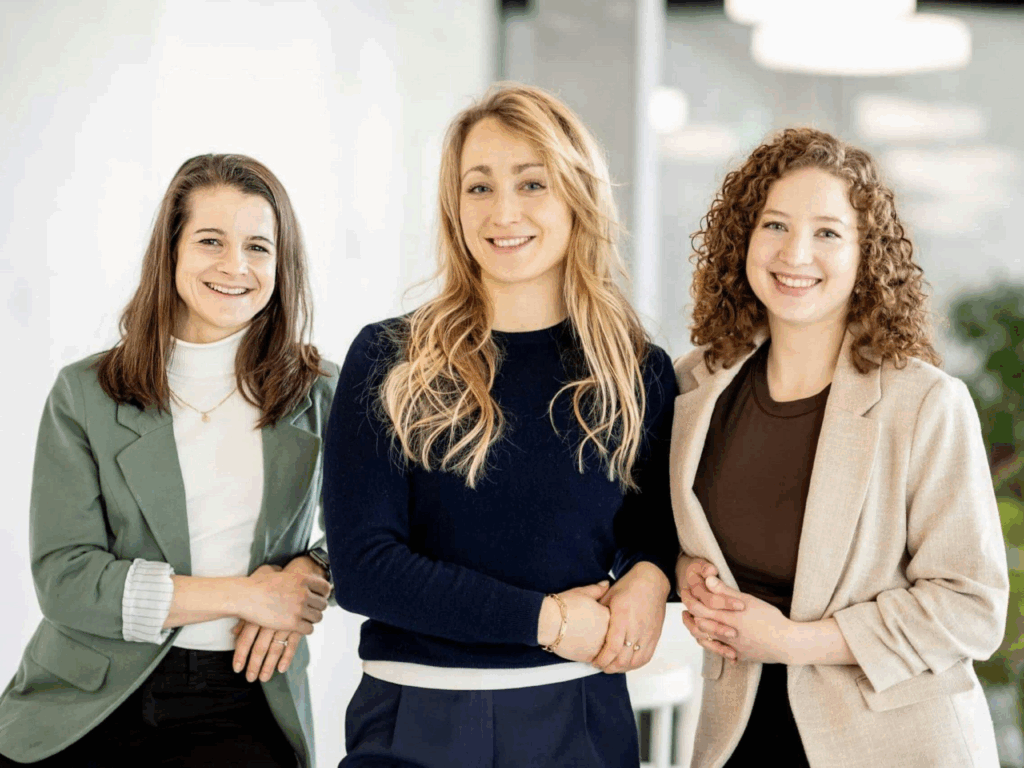
One of its recent participants, Sallea, is a Zurich-based startup pioneering sustainable food innovation. The company develops plant-based, edible scaffolds that enable the production of structured cultivated meat and fish products — think steaks and fillets — moving beyond the unstructured formats common today. Founded by Simona Fehlmann, Dr. Nicole Kleger and Anna Bünter, this all-female team combines scientific excellence with a sharp market vision, aiming to create realistic, cruelty-free alternatives that could transform the future of food.
As part of our deep dive into climate innovation, we sat down with Sallea to explore their mission, technology, and vision for the future.
INTERVIEW WITH SALLEA
Could you give us a brief overview of what Sallea does and the problem your solution addresses?
Sallea AG is a spin-off from ETH Zurich and is working on accelerating the market development of cultivated meat. Founded by three women, the start-up produces edible scaffolds that enable efficient, three-dimensional cell growth for the production of premium products such as steaks or fillets.
The problem we are solving within cellular agriculture is that today, cells can only be grown two-dimensionally or in small clusters, as they need a structure (so-called scaffolds) to adhere to and grow into a textured whole, cut like a steak. Therefore, output today is limited to low-priced products like sausages and chicken nuggets. For the industry to attract more investments and scale effectively, more attractive premium product categories are needed.
What motivated you to found Sallea? Was it more about addressing an existing challenge or the excitement of creating a solution?
We were motivated by three main reasons. Firstly, the opportunity to enable a more sustainable and cruelty-free way of growing meat and fish. Secondly, by turning research findings into a viable business model, including the development of a product from lab to market. Lastly, the opportunity to build a company, taking on significant responsibility, and by doing so, growing professionally as well as personally.
What is the bigger vision for Sallea?
We aim to be the leading provider of scaffolds and hardware for whole-cut cultivation, accelerating the transition to a more sustainable production of animal proteins.
The Swiss startup ecosystem is often seen as fragmented. How do you navigate this complex landscape when growing Sallea?
From early on sallea was supported by great organisations, events, and programs within the Swiss startup ecosystem, including ETH Zurich, Venture Kick, Mass Challenge, Innosuisse, GRS and so on.
These connections helped us navigate the ecosystem more effectively and introduced us to investors and fellow founders, often the best source for insider tips on valuable events and programs. In addition, organisations like the Swiss Food and Nutrition Valley (SFNV) play a key role in bringing startups, corporates, and investors together, fostering collaboration and knowledge exchange across the ecosystem.
If you could change one thing about the Swiss startup ecosystem overnight, what would it be?
To increase the availability of larger funding rounds/funds for scale-ups.
Public-private funding models like the KlimUp matching fund are not common in Switzerland. How do you view this approach in supporting early-stage climate-tech startups?
We believe this is a very reasonable way to allocate additional funding beyond traditional VC investments. Deep-tech companies, like sallea, often require significant capital well before they reach the market.
Unfortunately, closing a financing round can sometimes create the false impression that no further (non-dilutive) funding is needed. But in reality, these companies typically have a much longer time-to-market and continue to depend on substantial financial support.
Rather than reducing support after a successful round, we believe it should be viewed as a strong validation signal — a clear indication that the company is on the right track and worth backing further.
Besides the grant from the city of Zurich – did being selected for the KlimUp program help you in any other ways?
The program attracted and selected many outstanding startups and founders, facilitating valuable exchanges on common challenges.
For founders who are still hesitant to take the leap into entrepreneurship, what message would you share with them?
Go for it! It is a very valuable opportunity to learn and grow. We are fortunate to be in a country that offers exceptional resources, education, and social security. If we have an idea with the potential to drive change and create impact, we have both the opportunity and the responsibility to pursue it. With the advantages we have, we should make the most of them to contribute to meaningful progress.
Are you a Climate Tech startup looking to scale?
Bluelion is your launchpad! We provide early-stage support and access to up to CHF 250,000 seed funding from the Stadt Zürich, helping scalable Climate Tech startups grow.