Insights with KlimUp Jury Member Myke Näf
Why Investors are Betting on Climate Startups
ABOUT MYKE NÄF
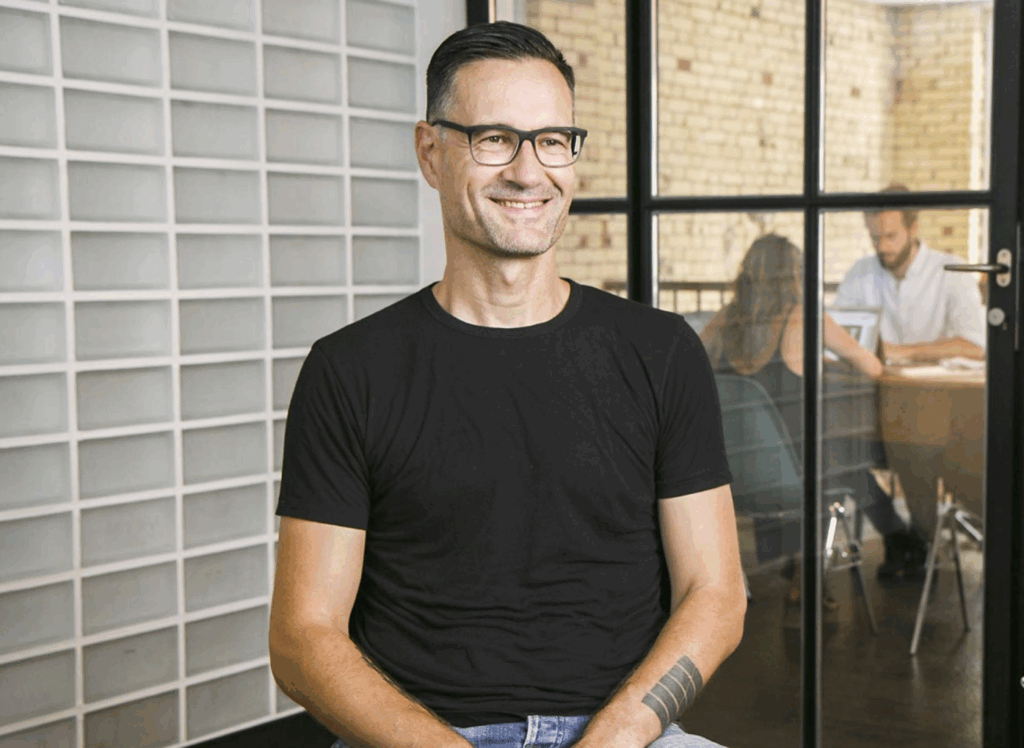
“Don’t build your business on the assumption that corporates or individuals will act out of goodwill, pay a green premium, or rely on regulation. Build something that makes solid business sense – independent of political currents or partisan trends.“
We collaborate with Myke Näf, Founding Partner at Übermorgen Ventures and jury member of the KlimUp commission board. In his role, Myke helps evaluate startups on both their climate impact and their business potential, ensuring that the program supports ventures with the ability to scale meaningful solutions. KlimUp provides up to CHF 250,000 in non-dilutive funding, giving early-stage startups the strongest possible launchpad to accelerate their pre-seed round on founder-friendly terms and with top-tier investors at their side.
As co-founder of Doodle and now climate-tech investor at Übermorgen Ventures, Myke brings both entrepreneurial experience and deep venture capital expertise to his work with KlimUp. His perspective bridges the realities of building companies from scratch with the challenges and opportunities of financing climate innovation today.
We spoke with Myke about the current state of climate tech investing, the challenges founders face in scaling hardtech, the role of AI in climate innovation, and why initiatives like KlimUp matter for the Swiss and European startup ecosystem.
INTERVIEW WITH MYKE NÄF
You’re deeply embedded in the climate tech investment space — what specific technology domains do you currently see breaking through the noise, and which ones do you think are overhyped or misaligned with real climate impact?
In every major vertical, there are temporary hypes that sometimes harm the entire sector, even though the vertical itself remains crucial.
Food & Ag seems especially prone to this, with past hypes around plant-based meat, alternative proteins in general, or vertical farming. The broader field, however, remains highly relevant, and I’d love to see more scalable innovation in areas such as regenerative agriculture, soil health, biodiversity, and beyond.
Another example is mobility, which has gone through its own hype cycles in personal and micromobility. Yet the broader sector remains compelling — for instance, with more industry-oriented use cases around cargo logistics or cold-chain transport.
Currently, AI is top of mind — it’s both generating a lot of noise and showing real potential, also in climate. Other important topics include energy storage, demand-side management, new baseload power generation, adaptation & resilience, and many more.
Hardtech and deeptech climate solutions often face a TRL valley of death — what models have you seen that actually work in getting technologies from lab to market in Europe?
The TRL “valley of death” is real. Crossing it takes time and a whole stack of capital sources: research grants, non-dilutive funding, angels, VCs, CVCs, national and international programs like Horizon Europe, infrastructure funds, debt instruments, philanthropic sources, family offices — in short, blended finance.
But it’s not just about the technology side of TRL. Founders also need to drive the commercial side in parallel. Start collecting demand signals early: letters of intent, pre-purchase agreements, customer feedback on samples, competitive unit economics. That’s what ultimately convinces both investors and customers. I like the DOE’s ARL framework (Adoption Readiness Levels) for capturing this balance between technology and market.
Climate tech often requires unusually long go-to-market cycles — what strategies should founders use to stay fundable in this slow-burn environment?
First: as a founder, don’t underestimate timelines. Everything takes longer — in climate, in deep tech, really in almost any startup journey. Plan for it, be patient, and think in terms of multiple funding rounds, not just the next one.
Second: stay aligned with your investors. The most difficult situations I’ve seen arise when a fund is nearing the end of its life while the startup still needs years. Open-ended funds like Übermorgen Ventures offer more flexibility here, and founders should actively look for investors whose time horizons match their own.
Finally: communicate progress beyond just revenues — milestones on technology readiness, customer engagement, unit economics, pilots — all help keep the narrative fundable over the long cycle. Use these successes to keep investors engaged so you’re never raising from a cold start.
With many VCs drifting toward private equity-style behavior — less risk, later stages, bigger checks — is early-stage climate VC slowly dying out? How do we protect the wild bets that are needed to drive systemic change?
I don’t believe early-stage climate VC is dying. There are still plenty of players willing to invest early. As some funds grow larger and shift toward bigger, later-stage deals, they create space for new funds that are smaller, more agile, and focused on early-stage opportunities. At its core, venture capital is about making bold bets that can generate outsized returns.
That said, scaling certain climate technologies is undeniably hard — which is why access to a diverse set of funding instruments remains essential.
With Trump back in office and already taking steps to defund climate science and roll back federal climate initiatives, how do you expect this to reshape the global climate tech landscape — and could this trigger a wave of European startups stepping in to fill the innovation and policy void in the U.S?
It’s still too early to know how this will play out. The current US administration certainly creates significant headwinds by introducing counteracting incentives, redirecting funds, curbing climate research, monitoring, and observation — and more broadly serving as a role model for various forms of climate denialism.
Europe, by contrast, continues to push forward with strong climate regulation, funding, and by keeping climate high on the agenda. Switzerland, in particular, could be well positioned to serve as a role model — provided there were broader support for such a stance.
At the same time, nations today face many other pressing priorities: defense, de-globalization, sovereignty, supply chain independence, to name just a few.
In this environment, it’s more important than ever for climate startups to build businesses that make sense regardless of political stances on climate. Moreover, some climate startups can benefit from the spillover effects of these other priorities, especially in the areas of adaptation and resilience.
AI is taking over everything from material discovery to energy optimisation. Is this the rising tide that lifts climate tech boats — or a distraction that will siphon off talent and capital?
All of these. AI is a huge distraction — consuming capital, compute, and attention, and turning many generalist VCs into AI-focused investors. At the same time, it represents a tremendous opportunity and underpins several of our investments, from process optimization to material discovery.
But AI is also a climate problem in itself — with massive datacenter buildouts, the compute required for training and inference, and the resulting emissions from buildings, energy use, and even water consumption. In turn, this creates new opportunities for efficiency innovations in AI and compute infrastructure.
Finally, AI has become an essential part of how we operate at Übermorgen Ventures. For the past three years, I’ve been developing a suite of AI tools that help us manage deal flow, oversee our portfolio, and walk into every meeting fully prepared. We call it üi — “ürtificial intelligence”.
KlimUp’s matching mechanism requires startups to raise from institutional investors before unlocking public funds — is this an effective filter for quality, or does it risk sidelining breakthrough but unconventional ideas that institutional VCs won’t yet touch?
It’s a good quality filter. With regard to unconventional ideas, I’d hope that there are VCs out there that are ready to back unconventional ideas. We certainly are at Übermorgen Ventures.
The KlimUp funding helps sweeten the deal for both unconventional and conventional ideas. And it provides a credibility boost as any supported startup needs to pass several gates before being approved for funding.
From your perspective as both a VC and KlimUp jury member, how do you handle the tension between short-term fundability and long-term climate impact when selecting startups for support?
From a KlimUp perspective, one of the advantages is that even long-term projects can receive an early financial boost. And since KlimUp doesn’t expect financial returns from its funding activities, it’s not a problem if a startup takes longer than average to reach maturity.
From a VC perspective, especially for us at Übermorgen Ventures with our open-ended setup, we aim to build a portfolio that is balanced across all relevant dimensions, and “long-term-ness” (or the time horizon toward a liquidity event) is one of them.
What role do you believe municipal-level programs like KlimUp should play in shaping the national innovation landscape — and what would need to happen for KlimUp to become a blueprint for Switzerland or even the DACH region?
KlimUp is a great initiative to channel more capital — and at an earlier stage — into climate startups, helping to bring technologies to market that address climate change.
It also creates opportunities for people across different departments to engage with the innovations pursued by startups, and vice versa. For some startups, this can lead to valuable contacts, learning opportunities, or even demand signals, since a city like Zurich can also be a potential customer for certain products or services.
In addition, KlimUp funding can provide early credibility, which can be crucial for some startups.
There’s also the non-profit track of KlimUp, which enables projects that are impactful but not VC-fundable due to a lack of scalability — for example, when the business model is inherently local.
Scaling to other municipalities or regions could be achieved by sharing success stories, lessons learned, and concrete playbooks.
What’s one piece of hard advice you’d give to first-time climate tech founders — especially those with a scientific background — that no one tells them until it’s too late?
Don’t build your business on the assumption that corporates or individuals will act out of goodwill, pay a green premium, or rely on regulation. Build something that makes solid business sense — independent of political currents or partisan trends.
For angel investors and aspiring climate tech VCs: What must they unlearn from traditional tech investing to succeed in this space?
Don’t unlearn anything. But adjust your lens. Climate tech is more complex than SaaS: it’s often harder to scale, comes with different KPIs, longer times to first revenue, greater emphasis on exploiting learning curves and managing supply chains, and entirely new types of moats.
And be prepared to re-learn what you studied in school — whether that’s chemistry, physics, or electrical engineering.
Are you a Climate Tech startup looking to scale?
Bluelion is your launchpad! We provide early-stage support and access to up to CHF 250,000 seed funding from the Stadt Zürich, helping scalable Climate Tech startups grow.